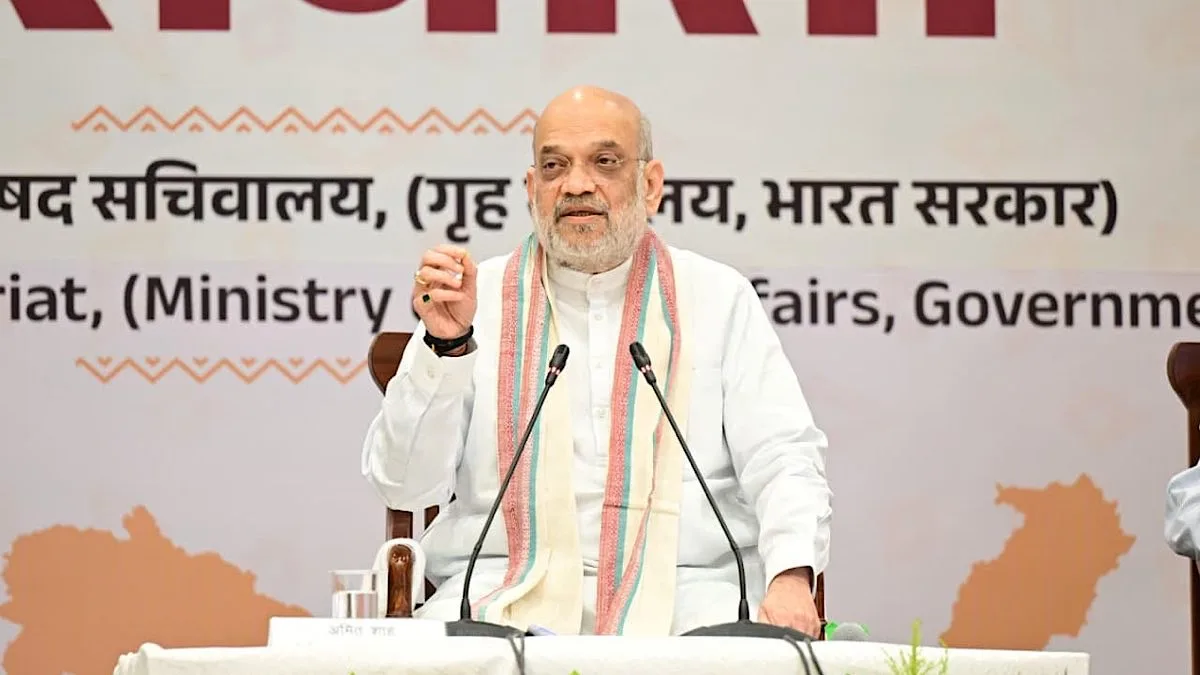
Union Home Minister Amit Shah on Tuesday chaired the 26th meeting of the Central Zonal Council in Jagdalpur during his two-day visit to Chhattisgarh. The meeting focused on internal security, inter-state coordination and development in Maoist-affected regions. His visit comes at a time when Maoist activity has declined significantly, with the government projecting a shift towards stability and development in Bastar.
Chief Minister Vishnu Deo Sai, Madhya Pradesh Chief Minister Mohan Yadav, Uttar Pradesh Chief Minister Yogi Adityanath and Uttarakhand Chief Minister Pushkar Singh Dhami attended the meeting. Discussions were centred on strengthening coordination among states, addressing shared challenges and preparing a joint roadmap for development and security. Sources said that the deliberations also focused on positioning Bastar as a model of peace and development. The high-level meeting, being held in the region for the first time following a decline in Maoist violence, is seen as a significant step towards building confidence and cooperation among states.
Advertisement
Addressing a press conference in Jagdalpur, Shah said that Bastar had entered a new phase. He said people no longer need to live in fear and described the moment as the beginning of a new sunrise for the region. He credited security forces for their role in making Bastar free from Maoist violence. He said their sacrifices, along with the resilience of their families, made this transition possible.
Shah said that nearly 200 security camps had been set up in Bastar during anti-Naxal operations. With the situation improving, 70 of these camps will be converted in the first phase into “Veer Shaheed Gundadhur Seva Dera” centres. These centres will provide services such as banking, Aadhaar registration, ration distribution, healthcare, education and digital access at the village level.
He said the government is working in line with Prime Minister Narendra Modi’s vision, following a clear path — security leading to trust, trust to development, development to prosperity, and finally to saturation of benefits. He added that the process would remain incomplete until every resident of Bastar is fully connected to the mainstream.
Highlighting the long-term impact of Maoist violence, Shah said that the region had fallen behind by 30 to 40 years. Schools could not function, roads remained incomplete, healthcare services were disrupted and banking facilities did not reach many areas.
To address this gap, he said, infrastructure development has been accelerated. Projects worth over ₹20,557 crore covering 12,211 kilometres of roads have been completed. Plans are also underway to install 13,000 mobile towers in affected regions, with around 5,000 already operational.
The Home Minister said that the government aims to increase the average income of Bastar’s residents sixfold over the next five years. Employment generation, especially for local youth, and economic empowerment of tribal communities will be key priorities.
He also highlighted cultural and community initiatives. The “Bastar Pandum” festival has seen participation grow from about 45,000 people in its initial phase to over 3.54 lakh. The “Bastar Olympics” has also drawn nearly 3.94 lakh participants, including youth from previously affected areas.
Shah said Common Service Centres will help deliver the benefits of 371 government schemes directly to villagers. He added that the proposed service centres would reduce the need for people to travel long distances for basic services.
He urged people, especially tribal youth, not to be influenced by those advocating violence. He said democratic participation and development offer a better and more sustainable path forward.
He said that Bastar’s transformation could serve as a model for other regions affected by conflict, showing how development and good governance can replace violence.